
WhatsApp Collection Workflow with AI
WhatsApp Collection Workflow with AI: How to Reduce Late Payments Before They Happen
By Gabriel Borges Aguiar · September 23, 2026 · 6 min read
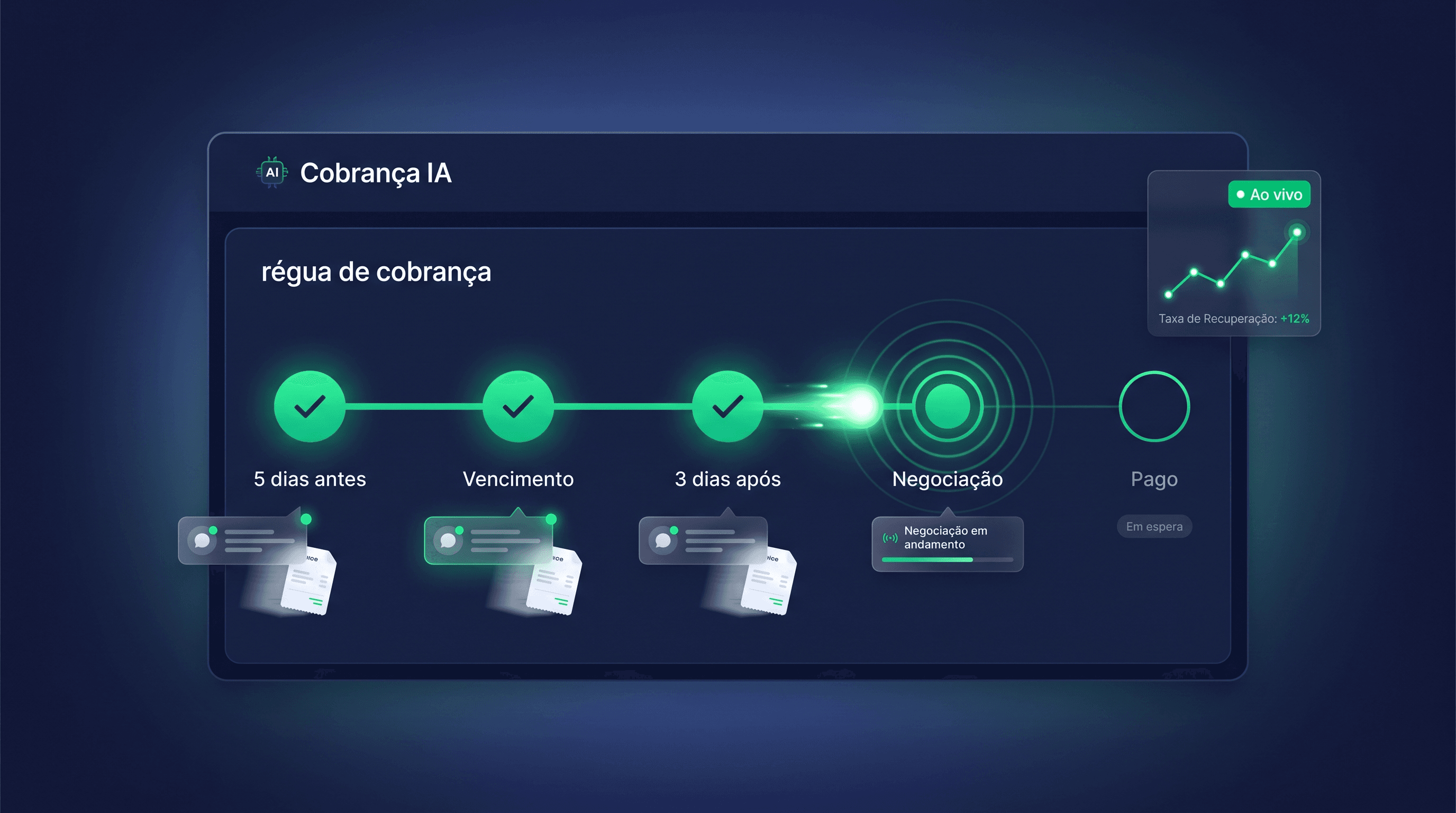
WhatsApp Collection Workflow with AI: How to Reduce Late Payments Before They Happen
The cheapest invoice to recover is the one that never becomes overdue. Yet most companies focus their effort after the due date, when the customer has already prioritized other bills, cash flow has already taken the hit and negotiation starts at a disadvantage. An AI powered WhatsApp collection workflow changes that starting point: contact begins earlier, happens on the channel customers actually read and follows the rules the company has set.
For finance leaders, the question is no longer whether WhatsApp belongs in collections. The question is whether the company can use it at scale, consistently and with control, without turning the team into a manual messaging desk.
Why prevention is worth more than recovery
Many late payments are not caused by lack of money. They come from forgetfulness, an invoice lost in an inbox, a question about the amount or a document that never reached the person who approves payment. These are operational delays, and each one carries the same cost as real delinquency: extra contacts, manual reconciliation and pressure on cash flow.
Acting before the due date solves these cases with a reminder, a copy of the invoice or a quick answer. The customer pays on time, the relationship stays intact and the team stops spending energy on accounts that never needed recovery in the first place. The smaller the overdue queue, the more time the team has for cases that truly require negotiation.
WhatsApp changed customer expectations, not the operation
B2B customers already handle orders and support through WhatsApp. They expect collections to work the same way: a clear message, the document at hand and an immediate answer when a question comes up. The problem is that many companies use the channel informally, with personal phone numbers, copy and paste messages and no central record.
That approach creates three risks: inconsistency, since each analyst writes and offers terms differently; lack of traceability, because conversations live on someone's phone; and regulatory and reputational exposure, from off hours messages, inappropriate tone or unofficial channels.
AI automation fixes execution while keeping the channel. Conversations stay on WhatsApp but follow a defined workflow, run on the official WhatsApp Business API and are logged in a dashboard management can access.
How an AI WhatsApp collection workflow works
An effective workflow combines timing, message and action. The AI reads invoice data, due dates, payment history and customer profile, then decides which step applies to each account.
Before the due date, the customer receives a reminder with the invoice or payment link. Customers with a history of delays can be notified earlier, while reliable payers get only a light confirmation.
On the due date, the message reinforces the deadline and makes immediate payment easy. If the customer replies with a question, the AI clarifies amount, date or document in the same conversation.
After the due date, tone and frequency adapt to the delay range. When there is room for an agreement, the AI presents the terms the company has approved, such as progressive discounts, down payments and installments.
The key difference is that the workflow is not a bulk messaging tool. It reacts to customer behavior: it stops contacts as soon as payment is detected, reschedules when there is a payment promise and escalates to a person when a case falls outside policy.
From conversation to confirmed payment
Collection ends only when money arrives. The workflow must be connected to payment recognition, invoice settlement and document delivery. Without that link, the team keeps checking receipts by hand and customers who already paid risk receiving another reminder.
Compliance: what WhatsApp collections cannot skip
Collecting by message requires the same care as any other channel. Consumer protection rules prohibit embarrassing, threatening or pressuring debtors, and data privacy laws require proper handling of the information used in each conversation.
In practice, the workflow should respect contact hours, use objective and respectful language, speak only with the person responsible for payment and run on the official WhatsApp Business API with approved message templates. A well configured AI applies these rules in every conversation, something hard to guarantee when each contact depends on a different person.
Metrics that prove the workflow is working
Messages sent do not measure results. Track the on time payment rate, the share of invoices settled after a preventive reminder, time between due date and payment, response rate by workflow step and the share of cases resolved without human intervention.
Compare segments as well. If a step drives many replies but few payments, the message may be clear while the payment method is not. If a customer group only pays after the third contact, the first reminder may need to go out earlier. With real time data, these adjustments no longer wait for month end.
Four steps to implement without disrupting finance
Map your current workflow. List when and how each customer is contacted today, before and after the due date. This reveals where the process depends on manual effort.
Set rules and limits. Define contact hours, frequency, tone by delay range, allowed discounts, installment limits and escalation criteria. Clear rules let the AI act with autonomy and safety.
Connect data and payments. Integrate your financial system so the AI checks the real status of each invoice and recognizes payments automatically.
Start with one portfolio, then scale on results. Activate the workflow in one segment, review conversations, compare against your baseline and expand.
Cobrança IA was built for this model: more than 30 AI agents handle reminders, negotiation, invoice copies, payment settlement and agreements on WhatsApp, while the company configures rules and playbooks directly in the admin panel, with no dependence on outside teams for daily operations.
What to evaluate before choosing a platform
Check whether the platform uses the official WhatsApp API, lets you configure the workflow without development, recognizes payments and stops contacts automatically, and keeps a full history of every conversation. Also assess its ability to negotiate within rules, not just send date reminders.
Delinquency does not start the day after the due date. It starts when the customer does not get the right information, on the right channel, at the right time. An AI powered WhatsApp collection workflow acts in exactly that window and turns collections into a predictable cash routine.
FAQ
What is a WhatsApp collection workflow?
A planned sequence of WhatsApp contacts before and after the due date, with defined messages and actions for each stage of an invoice.
Is it allowed to collect payments through WhatsApp?
Yes, as long as communication follows consumer protection and data privacy rules, with respectful language, proper hours and the official WhatsApp Business API.
Can AI negotiate on its own?
Yes, within limits set by the company, such as maximum discounts and number of installments. Cases outside policy are escalated to a person.